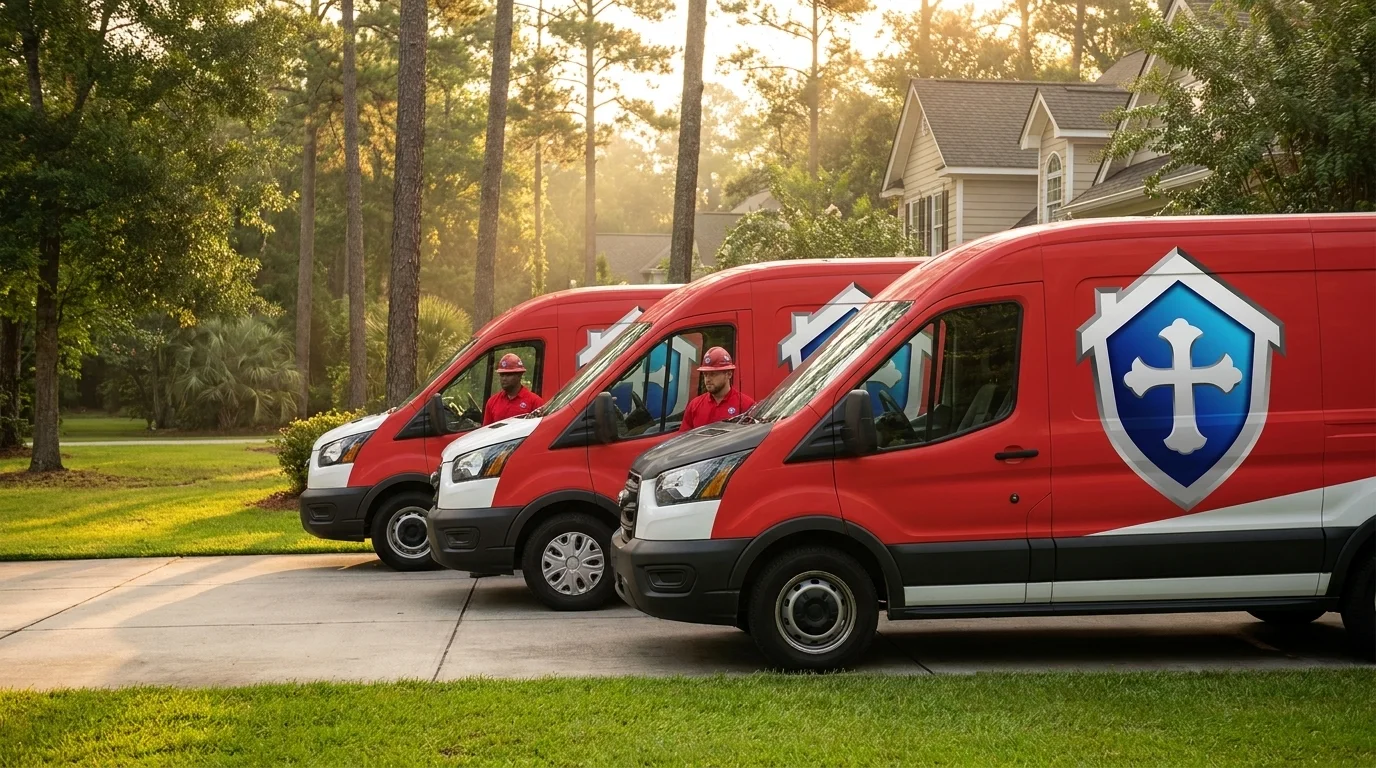
24/7 Emergency Board-Up and Tarping in Indian Trail
24/7 emergency board-up and tarping in Indian Trail and surrounding areas. IICRC-certified technicians, insurance billing accepted. Call (980) 470-7725.
Hole in your roof or a window blown out in the storm? Call now, we answer 24/7. Every hour a structure sits open to the weather, rain finds a new path into insulation, drywall, and framing, and an unsecured door or window turns a storm loss into a break-in risk. Emergency board-up and tarping stops that second wave of damage before it starts, buying time for the real repair or insurance process to catch up.
What Emergency Board-Up and Tarping actually involves
This is the stopgap work that happens between the damage and the permanent fix: covering broken windows and doors with plywood, stretching heavy-gauge tarps over exposed roof sections, and sealing gaps where wind-driven rain gets behind siding or soffits. It’s physical, exterior work, done in whatever weather caused the problem in the first place, which means it has to be fast and it has to hold. A tarp that lifts in the next gust didn’t do its job. A board-up that leaves a gap at the sill or jamb still lets water track down into the wall cavity.
Common triggers in our area include wind-driven limbs through a roof deck, hail or impact damage to windows, a fire department forcing entry during a fire response, and vehicle or storm impact to exterior walls. In every case the goal is the same: close the envelope, stop active water or air intrusion, and secure the structure against unauthorized entry until permanent repairs or reconstruction can be scheduled.
Our process
- Site safety check. Before anyone climbs a ladder or steps near a damaged opening, we look for downed power lines, unstable framing, broken glass, and roof sections that won’t hold weight.
- Measure and cut for a tight fit. Plywood for windows and doors is cut to the actual opening, not just laid over it, so it seats against solid framing rather than loose trim.
- Tarp the roof with batten strips, not just nails. Tarps get sandwiched between wood batten strips and fastened through the tarp into solid decking or rafters, which spreads the load and keeps wind from working a single fastener loose.
- Seal and secure the perimeter. Edges get sealed against wind-driven rain, and openings are locked down to prevent unauthorized access while the property may sit vacant or under repair.
- Photo-document everything before and after. Every covered opening and tarped section gets photographed, which becomes part of the record your insurance carrier will ask for.
What separates a good board-up response from a bad one
The most common failure point is fastening. Tarps stapled or nailed flat without batten strips tear loose in the next wind event, and plywood screwed only into trim rather than studs pulls away under its own weight. A rushed crew will also skip photographing the damage before covering it, which creates problems later when an adjuster asks what the opening actually looked like. Good work means working from the structure out: finding solid framing to anchor into, covering roof penetrations completely rather than just the obvious hole, and checking for secondary damage, like a window frame that’s cracked but not fully broken, that still needs protection even though it looks intact.
What does Emergency Board-Up and Tarping cost?
Every property and every type of damage is different, so SkyGuard Restoration provides a written scope before work begins rather than a number over the phone. Homeowners insurance typically covers emergency board-up and tarping as part of mitigating further damage under a covered peril, though coverage specifics depend on your policy. Industry-typical ranges for this kind of work look like this:
| Scenario | Typical range |
|---|---|
| Single broken window | $150 - $400 |
| Sliding glass door or French door | $300 - $600 |
| Standard roof tarp, one slope | $400 - $1,500 |
| Large or multi-section roof tarp | $1,500 - $4,000 |
| Full exterior board-up after fire or storm | $800 - $2,500 |
Seasonal & regional considerations
Spring and summer bring fast-moving thunderstorms and the occasional hurricane remnant through the Charlotte region, usually with enough wind to bring down limbs onto older roof decking. Winter ice storms are less frequent but can snap branches under their own weight. Indian Trail and the surrounding area have a mix of older homes with plank roof decking and newer construction with OSB sheathing, and the two respond differently to impact damage, which is part of why we assess decking condition before we decide how a tarp gets anchored.
Service area
SkyGuard Restoration handles emergency board-up and tarping across Indian Trail, Charlotte, Concord, Monroe, Matthews, Mint Hill, Waxhaw, Stallings, and Weddington.
If wind, fire, or impact has left your home open to the weather or to the street, don’t wait on it. Call (980) 470-7725 to request emergency board-up and tarping and get the structure secured tonight.
Frequently Asked Questions
Does homeowners insurance cover emergency board-up and tarping?
How long will a tarp or board-up hold before I need permanent repairs?
What materials do you use for roof tarping versus window board-up?
Will boarding up a broken window or door after a fire interfere with the insurance investigation?
What should I do with damaged openings before you arrive?
Looking for the best emergency board-up and tarping company in Indian Trail?
SkyGuard Restoration provides emergency board-up and tarping in Indian Trail, NC and the surrounding area, and has served local property owners since 2024. Customers rate us 5.0 out of 5 stars across 7 Google reviews. We answer calls 24/7 — call (980) 470-7725 for immediate help.
Need Emergency Board-Up and Tarping now?
We respond 24/7 across Indian Trail and surrounding NC cities.